
Youth Games
What is a Tabletop Role-Playing Game?
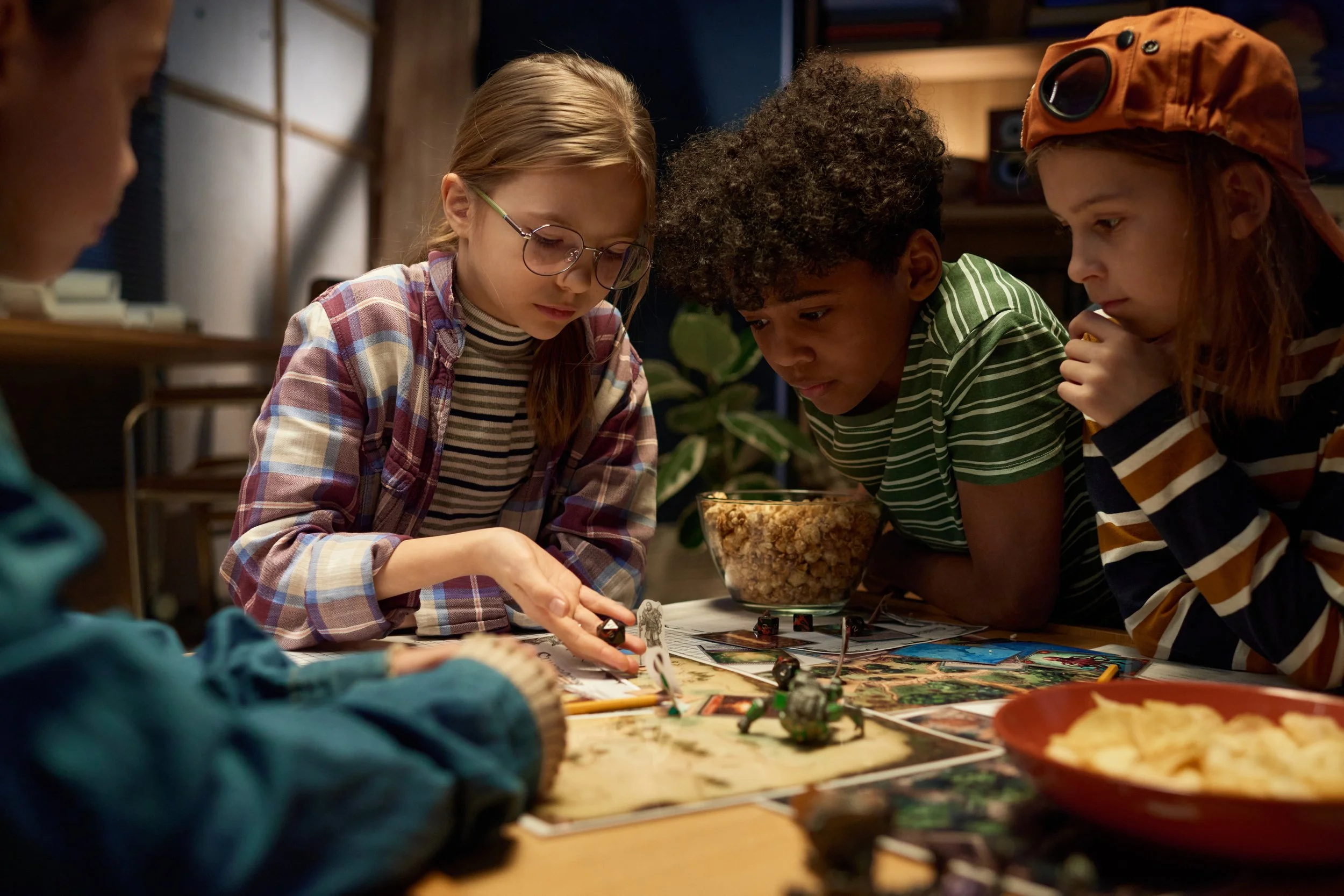
Tabletop role-playing games (TTRPGs) are a form of collaborative storytelling where players create characters and work together to solve challenges within an imagined world. Unlike competitive games, TTRPGs emphasize shared narrative, creative problem-solving, and social interaction.
Why Schools and Youth Programs Are Embracing TTRPGs?
Educators, librarians, and youth program leaders are increasingly using tabletop role-playing as a tool for learning and engagement. In an environment where young people spend more time on screens than ever before, TTRPGs offer a structured, screen-free space for imagination, conversation, and sustained attention.
According to the American Library Association’s youth services division (ALSC), TTRPG programs are showing up in schools and libraries because they help young people develop social skills while encouraging creativity and sustained attention.
Research and educational organizations also recognize tabletop games for their role in building social-emotional learning and durable real-world skills. For example, NextGen Learning describes how games like Dungeons & Dragons can support problem-solving, communication, and collaboration — skills that go beyond the game table.
Why Professional Facilitation Matters
Casual gaming with friends can be fun — but games led by skilled storytellers offer something different.
A professional storyteller:
Ensures age-appropriate content
Sets clear expectations for behavior and participation
Balances spotlight time so every child contributes
Guides learning without dominating the creative process
Creates a space where every participant feels safe to take risks
Because of this, professionally led sessions are not just “games.” They are more structured, content-aware, and provide better growth opportunities.
How NOVA Youth Sessions Work
Each NOVA Youth Session includes:
All the materials needed to play: dice, character sheets, and access to books
A customized game to meet the players where they are on their TTRPG journey
Guided character creation and simplified options where needed
Clear communication with both players and parents about the themes of the game
Optional educational debrief (especially valuable in school settings)
Group Size: Typically 4–6 players
Session Length: 2–3 hours (can be customized)
Format: In-person or virtual
The Benefits of Tabletop Gaming for Kids
Communication & Expression
Players must articulate ideas, describe actions, and interact with peers in a group setting. These verbal interactions help build speaking and listening skills.
“Games like Dungeons & Dragons create opportunities for students to practice expressing ideas, asking questions, and engaging in group dialogue.” — NextGen Learning
Creative Thinking & Problem Solving
Tabletop play revolves around open-ended challenges where there isn’t one “correct” answer. Participants learn to test ideas, evaluate consequences, and adapt plans — skills that mirror critical thinking processes used in school and life.
The Swords & Stationery site highlights how role-playing games encourage learners to think beyond fixed solutions by exploring narrative possibilities and making decisions that influence outcomes.

Collaboration & Teamwork
Playing a TTRPG depends on cooperation. Players listen to one another, share turns in decision-making, and make plans together when faced with group challenges. Those shared moments strengthen friendships, encourage empathy, and teach kids how to work as part of a team.
Building Confidence Through Challenge
Tabletop games naturally include uncertainty. Players make decisions, take risks, and respond to outcomes they can’t fully control.
Navigating those moments helps young people build confidence patience, flexibility, and the ability to recover when things don’t go as expected. Instead of avoiding challenges, they learn to work through them — together.
External Resources
For parents and educators who want to explore the evidence themselves, here are some excellent online resources, educational links, and research papers:
Supporting Student Development With Tabletop Games — Edutopia
https://www.edutopia.org/article/supporting-student-development-role-playing-gamesTTRPGs and Cognitive/Social Skills — National Library of Medicine
https://pmc.ncbi.nlm.nih.gov/articles/PMC11299717Social-Emotional Skill Practice in Games — TTRPGkids
https://www.ttrpgkids.com/2023/12/06/using-ttrpgs-to-teach-kids-social-emotional-skillsWhy Role-Playing Games Benefit Children’s Learning — Swords & Stationery (Informational)
https://swordsandstationery.com/learning/tabletop-games-benefit-children-learning/Dungeons & Dragons and Durable Skills — NextGen Learning (SEL + academic benefits)
https://www.nextgenlearning.org/articles/dungeons-dragons-durable-skills-sel-academicsIntroducing Dungeons & Dragons to School-Aged Children — Association for Library Service to Children
https://www.alsc.ala.org/blog/2022/07/introducing-dungeons-and-dragons-to-school-aged-childrenPeer-Reviewed Summary on TTRPG Psychological and Social Impact — DovePress
https://www.dovepress.com/a-scoping-review-of-tabletop-role-playing-game-ttrpg-as-psychological–peer-reviewed-fulltext-article-PRBM